
Tank Farm & Inventory
Integrating multi-brand ATGs into one TMS: protocols, gateways and testing
ATGs from different brands speak different protocols. An interface unit or gateway translates them into one format, and each tank is then tested against a manual dip.
- Topic
- Tank Farm & Inventory
- Updated
- 13 November 2026
- Reading time
- 6 min
- Sections
- 8
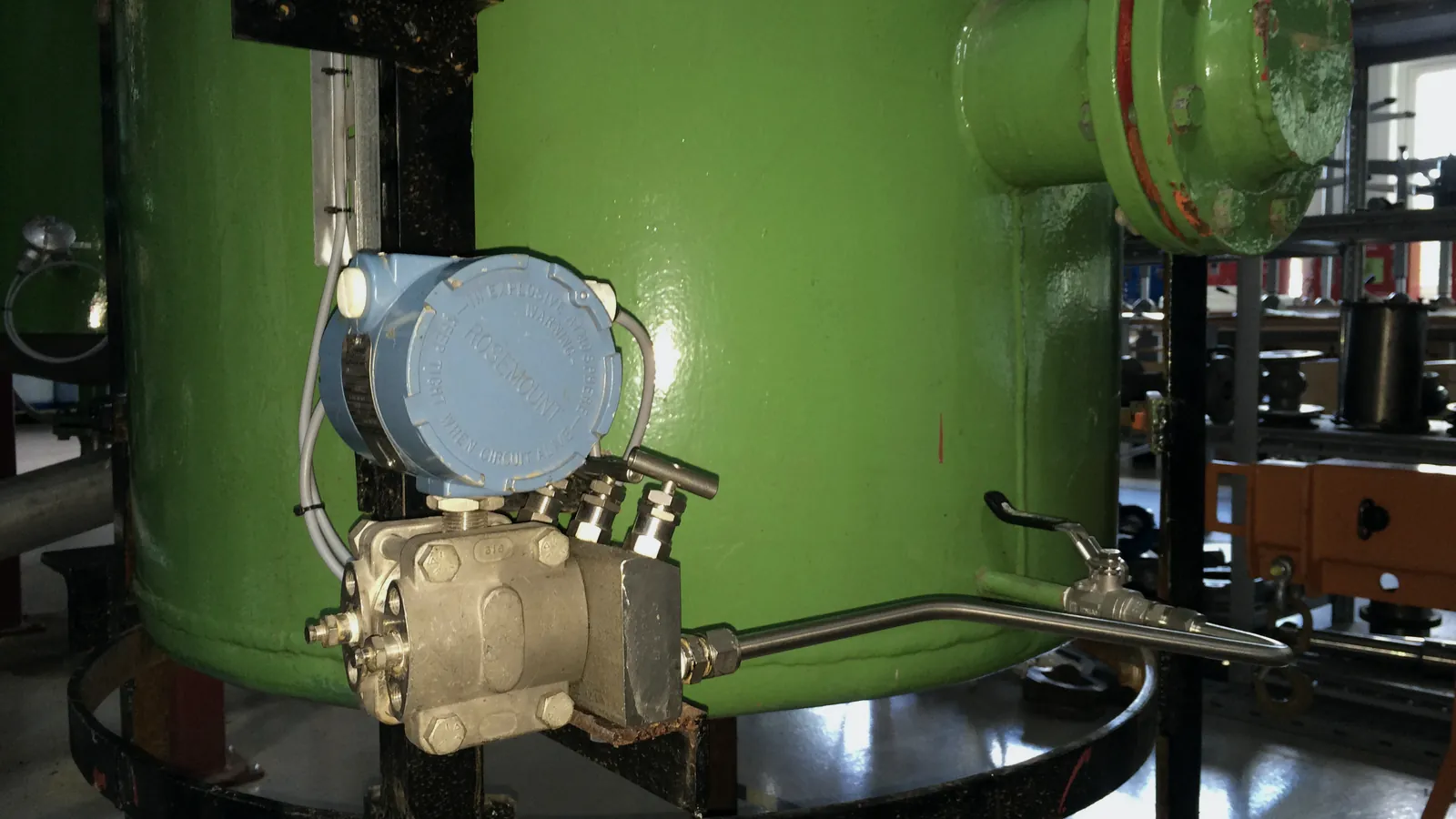
ATGs from different brands usually speak different protocols, so integrating them into one TMS is done through an interface unit or gateway that translates level, temperature and status into one format, and each tank is then tested against a manual dip.
Many Indonesian terminals carry gauges from several suppliers, installed in different decades. The basics of automatic tank gauging (ATG) are the same for all of them, but the way each gauge reports its reading is not. This guide covers the protocols, the gateway architecture, how to map the data into one model and how to test the result before the tank management system relies on it.
Protocols
Why ATG brands do not talk to each other
A gauge is a small computer on a tank roof, and each manufacturer chose its own way for that computer to talk.
Older installations often use a proprietary field bus that only the maker's interface unit understands. Newer gauges commonly offer Modbus RTU over RS-485 or Modbus TCP over Ethernet, and some add HART or a vendor protocol alongside. Even within one brand, the model, firmware and installed interface card decide what is available. The ATG integration checklist makes the same point: experience with one device does not mean every model or configuration behaves the same way.
Modbus helps, but it is not a common language for tank data. The Modbus Organization publishes the application protocol and the serial line specification, which define how registers are read, not what each register means. One gauge may report level in millimetres as an integer, another in metres as a floating-point value, with a different word order. The integration work lies in that mapping, and a mistake there produces values that look reasonable but are wrong by a fixed factor.
Architecture
Reference architecture: interface, gateway, TMS
The usual answer is a layered path: each gauge family talks to its own interface, and one gateway turns everything into a single stream for the TMS.
Where a brand uses a proprietary bus, its interface unit sits in the field or in the control room and exposes the readings, often over Modbus. Gauges that already speak Modbus can connect to the gateway directly.
The gateway polls every source, converts units and data types, adds a time stamp and a quality flag, and serves one consistent data set to the TMS server over Ethernet. API MPMS Chapter 3.1B treats data collection, transmission and receiving as part of the gauging system, so this path belongs in the measurement design, not only in the IT design.
Proprietary field bus from the manufacturer.
Hover, focus or tap a step to read its note.Data model
Mapping every gauge into one data model
The TMS should never need to know which brand sits on which tank. It should see the same fields, in the same units, for every tank.
Define the target model first: tank tag, level, average temperature, water level, gauge status, time stamp and a quality flag. Then map each source into it. For every register, record the address, data type, scaling, unit and word order, and document the source in the integration file. Status bits deserve as much care as values: a gauge in fault, in calibration or in manual mode must not look like a healthy reading.
The example on the right is a simplified tag map. Real addresses come from each vendor's protocol manual for the installed model and firmware, never from another site's configuration.
# Example only: normalised tag map (not a vendor register map)
# target field   source A (interface unit)   source B (native Modbus)
T-xx.level_mm    reg A+0  int32  scale 1    reg B+0  float32  m  x1000
T-xx.temp_c      reg A+2  int16  scale 0.1  reg B+2  float32  C
T-xx.water_mm    reg A+3  int32  scale 1    reg B+4  float32  m  x1000
T-xx.status      reg A+5  bits             reg B+6  bits
T-xx.timestamp   gateway clock              gateway clock
T-xx.quality GOOD / STALE / FAULT GOOD / STALE / FAULTChecklist
What to check on every tank
Integration is accepted tank by tank, not system by system. A dashboard that shows plausible numbers for every tank can still have two tanks swapped.
The table below lists the checks that catch most mistakes, from swapped tags to alarms that never reach the screen. Acceptance limits for value comparisons should be agreed with operations and the metrology requirements before the test, so nobody argues about the result afterwards.
| Criterion | How to check | Evidence to keep |
|---|---|---|
| Identity | Change the level at one tank and watch which tag moves | Tag list with device addresses |
| Level | Compare with a manual dip, tank at rest | Dip sheet and ATG value at the same time |
| Temperature and water | Compare with a portable thermometer and water cut | Field readings and TMS values |
| Status and alarms | Force gauge fault and alarm states where safe | Screenshots and event log |
| Loss of link | Disconnect the gauge or interface and watch the TMS | Stale flag and communication alarm raised |
Testing
Testing in four layers
Testing follows the data path from the bottom up. A failure found in the lowest layer saves hours of guessing in the TMS, especially when the application team and the instrument team work from different places.
The ATG integration checklist recommends separating measurement, communication and data processing, because on legacy equipment a power or converter fault can look like an application fault. Test communication first, then values, then alarms, then what happens when something fails. Keep the test on a schedule agreed with operations, with work windows, area access and configuration change limits set in advance.
Communication
Every gauge answers its poll; error and retry counters stay low over a full day.
Values
Level, temperature and water match field checks on each tank within the agreed limit.
Alarms
Gauge alarms and status reach the TMS with the right tank and time.
Failover
Loss of a gauge, the interface or the gateway produces a stale flag and an alarm, and recovery is clean.
Reliability
Protecting the link: power, surges and spares
Once integrated, the weakest part of the system is rarely the gauge. It is the chain of power supplies, cables, converters and gateways that carry the reading.
Tank farms are exposed to lightning, and long field cables pick up surges and carry them to the devices at each end.
At the Jambi fuel terminal in 2026, Citia replaced the ATG gateway, an Advantech ECU-1051, and added surge protectors on both the RS-485 Modbus line and the Ethernet line; the project notes say such protection should be installed from the start. In the ATG power supply repair at Redeco in 2025, a surge left an Endress+Hauser ATG dead with a blown fuse and a damaged varistor. Intermittent drops on the serial side are covered in troubleshooting Modbus on RS-485.
Spares are the other half. Interface modules go out of production long before tanks do. A long-term service agreement (LTSA) for the gauging system should list the critical spares, who holds them and the migration path when a part can no longer be bought. The ATG high alarm also depends on this chain, which is one more reason to keep independent high-high alarms on a separate path.
Security
Network and access around the gateway
The gateway sits on the border between the field network and the office network, which makes it a security device as much as a translator.
Keep the gauge network separate from the office network, and let the gateway or the TMS server be the only bridge. Read-only polling is the normal mode; write access to gauge configuration should be limited to engineering laptops under a work permit. Change default passwords on gateways and interface units, record who can log in, and keep a backup of every configuration file with its date.
Citia's bulletin on tank monitoring data security makes the same point from the operations side: integration with SCADA and ERP has to come with access protection, or the data loses its integrity. A tank figure that anyone can overwrite is no better than a handwritten one.
Separate networks
Gauge network apart from the office, one controlled bridge.
Read-only polling
Write access to gauges only under a work permit.
Named logins
Default passwords changed, users recorded.
Configuration backups
Every gateway and interface file kept with its date.
In the field
Field notes from Citia integration work
Citia's own records show where multi-brand integration succeeds and where it stalls.
Citia's technical bulletin on Tokyo Keiso and Endress+Hauser integration describes bringing gauges from both makers into one central system through compatible protocols, with the central system configured to receive and process the data in real time. INTEGRA TMS is described as working with ATGs from Honeywell, Endress+Hauser and Tokyo Keiso.
The Redeco ATG assessment in 2024 shows the harder case. Analog and digital gauges sat side by side, IFX-20000 interface modules had blown fuses and voltage drops, and those modules were discontinued. Communication was restored and readings were compared with stick measurements, but the evaluation concluded that accuracy could not be guaranteed on equipment past its life, and migration was recommended. Integration cannot fix a sensor that no longer measures well; an assessment should say so early.
The practical sequence that follows from these cases is simple. Assess the installed gauges first, decide which to keep, repair or replace, and only then design the gateway layer. Integrating a gauge that will be replaced next year doubles the testing work.
Citia ATG integration records
- 2024
Redeco ATG assessment
Mixed analog and digital gauges, discontinued interfaces, migration advised.
- 2025
Redeco ATG power supply
Surge damage repaired; grounding and surge protection reviewed.
- Sep 2025
Tokyo Keiso and Endress+Hauser bulletin
Two gauge makers brought into one central system.
- 2026
Jambi ATG gateway
ECU-1051 replaced, RS-485 and Ethernet surge protection added.
Terms used in this guide
- Interface unit
- Vendor device that reads gauges on a proprietary bus and exposes the data.
- Gateway
- Device that polls several sources and converts them into one protocol and data model.
- Modbus RTU / TCP
- Open protocol for reading registers, over serial lines such as RS-485 or over Ethernet.
- Register map
- List of addresses, data types and meanings a device exposes.
- Quality flag
- Marker that tells the TMS whether a value is good, stale or faulty.
- LTSA
- Long-term service agreement covering maintenance, spares and support over the system life.
Frequently asked questions
Can Tokyo Keiso and Endress+Hauser ATGs work in one system?
Yes, ATGs from Tokyo Keiso and Endress+Hauser can feed one system through compatible protocols and a gateway, as Citia has described in its technical bulletin. Each installed model and firmware still has to be checked, because compatibility depends on the actual device.
What happens when the ATG gateway fails?
When the gateway fails, every tank behind it stops updating in the TMS. A well-built TMS flags the values as stale and raises a communication alarm; operators switch to manual dips until the gateway is repaired and tested end to end.
How do you validate integrated ATG data?
Validate integrated ATG data tank by tank: confirm identity, compare level with a manual dip at rest, check temperature and water, force alarms where safe, and test loss of link. Keep the evidence for each tank.
Do all ATGs support Modbus?
No, not all ATGs support Modbus. Many newer gauges offer Modbus RTU or TCP, but older ones often use a proprietary bus that needs the maker’s interface unit, and even Modbus devices use different register maps.
What is an ATG LTSA?
An ATG LTSA is a long-term service agreement for the tank gauging system, covering maintenance, troubleshooting, spare parts and support over several years. A good one also names the migration path for parts that go out of production.
Should we replace all ATGs with one brand?
Not necessarily; a gateway can integrate several brands at lower cost than full replacement. Replacement makes sense where gauges are past their life, spares are gone or accuracy can no longer be shown against manual dips.
Sources and further reading
- Modbus Specifications (application protocol and serial line) (opens in a new tab)
- Petroleum Measurement catalog: MPMS Chapter 3.1B (data collection, transmission and receiving) (opens in a new tab)
- ECU-1051 industrial communication gateway (opens in a new tab)
- ATG data integration: Tokyo Keiso and Endress+Hauser protocol compatibility (opens in a new tab)
- Jambi fuel terminal: replacement of ATG gateway (ECU) spare part (opens in a new tab)
- Redeco ATG fault investigation (opens in a new tab)
- Redeco: ATG power supply module service (opens in a new tab)
- What to prepare before an ATG integration assessment (opens in a new tab)
- Cover photo by Bitjungle, CC BY-SA 4.0 (cropped and colour graded) (opens in a new tab)
Next step
Prepare the technical discussion for your facility.
Bring the equipment list, diagrams and symptoms you have. The Citia team helps map the next step.
Related products and solutions
- KnowledgeAutomatic tank gauging (ATG) for fuel tanks: types, working principles and accuracyAn automatic tank gauge (ATG) reads level, temperature and water in a storage tank continuously and turns them into volume with the tank calibration table.
- KnowledgeWhat is Modbus? RTU vs TCP, registers and function codesModbus is an open protocol for industrial devices. This guide compares Modbus RTU and TCP and explains registers, function codes, frames and gateways.
- KnowledgeIndustrial IoT gateways and telemetry: getting remote-site data to a dashboardAn industrial IoT gateway reads field devices, buffers data when the network drops and sends it to a server. How telemetry differs from SCADA and how to choose a gateway.
- KnowledgeWhat to prepare before an ATG integration assessmentDevice lists, protocols, tank tables and network conditions make TMS integration discussions more precise.
- ProductINTEGRA TMSCollects ATG readings from every tank for live levels, history, tank tickets and stock posting to SAP.
- ProjectJambi fuel terminal: replacement of ATG gateway (ECU) spare partThis project replaced the spare part Gateway ATG ECU-1051 Advantech at the Jambi fuel terminal to restore data communication between the Automatic Tank Gauging (ATG) and the Tank Management System (TMS) application.
- ProjectRedeco ATG fault investigationATG equipment assessment and communication restoration
- ProjectRedeco: ATG power supply module serviceAn Endress+Hauser ATG power supply that died after a lightning surge was repaired by replacing a blown fuse and a damaged varistor, then tested and reinstalled.
- NewsATG data integration: Tokyo Keiso and Endress+Hauser protocol compatibilityCovers Tokyo Keiso and Endress+Hauser ATG data integration through compatible communication protocols for tank level monitoring.