
Metering
Flowmeters for fuel: types, working principles and how to choose
Fuel flowmeters measure volume or mass; PD, turbine and Coriolis are the usual choices at a loading bay. Compare principles, accuracy classes and selection.
- Topic
- Metering
- Updated
- 13 November 2026
- Reading time
- 5 min
- Sections
- 8
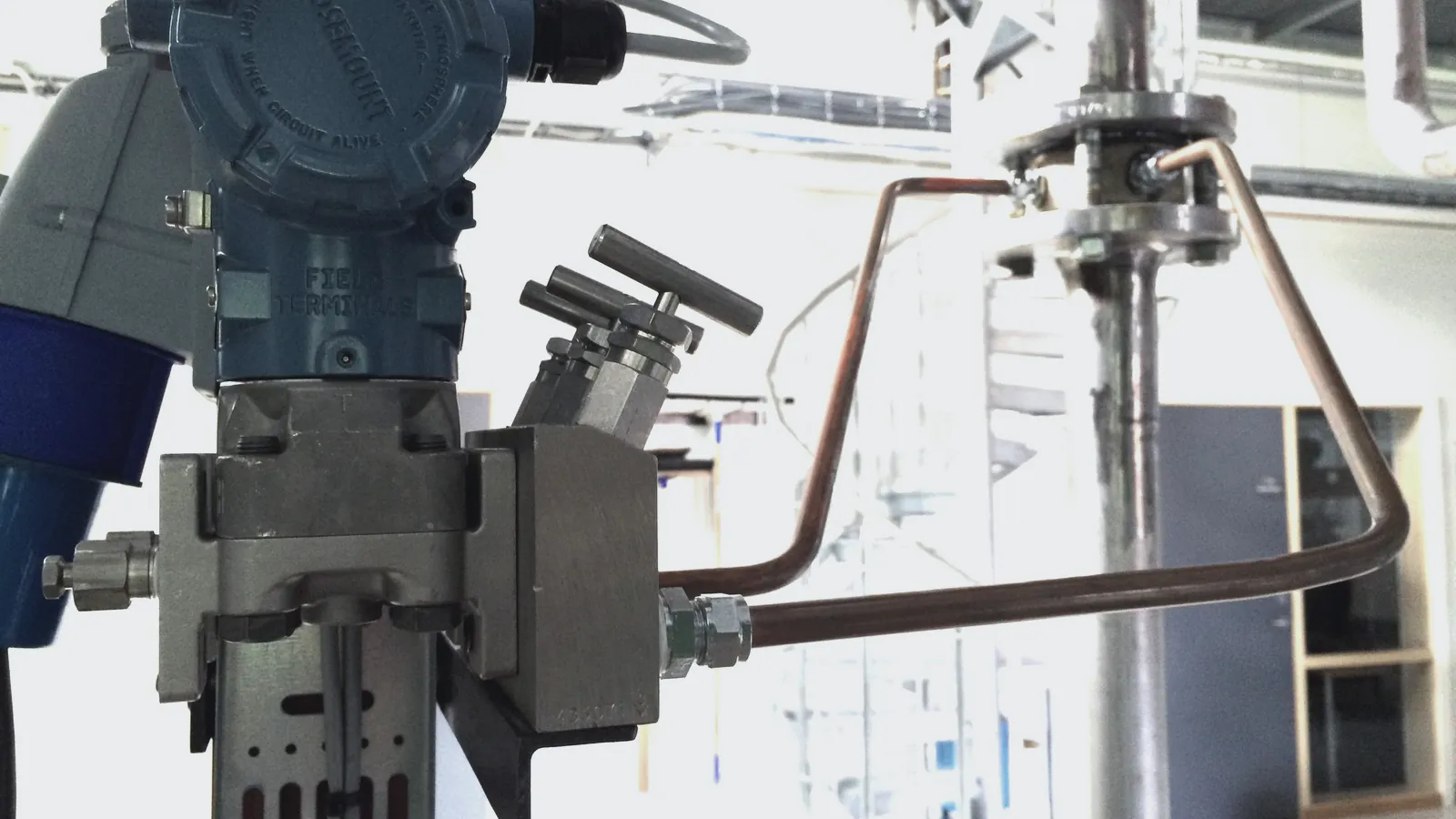
A fuel flowmeter measures the volume or mass of fuel that passes through a pipe; at a terminal loading bay the most common types are positive displacement (PD), turbine and Coriolis meters, chosen by the product's viscosity, the flow rate, the accuracy needed and the cost of keeping the meter in good condition.
In plain terms, the flowmeter is the till of a fuel terminal. Every litre that a customer pays for passes through one, so its type, installation and testing decide whether both sides trust the number. This guide compares the main types, explains how each one works, and gives a short procedure for choosing. It sits in a series with legal metrology and tera and meter proving and flow computers, which cover the testing side.
Basics
Volume, mass and standard volume
A flowmeter reports what flowed past it under the conditions at that moment, and fuel changes volume with temperature.
A PD, turbine or ultrasonic meter reports volume at metering conditions. Because the same mass of fuel occupies more volume when warm, trade usually converts the reading to volume at base conditions, using the temperature measured at the meter.
A Coriolis meter measures mass directly, and also density, so it avoids part of that correction. Which quantity the contract uses, volume at base conditions or mass, decides what the meter and its flow computer must deliver. OIML R 117-1 treats all three as valid quantity indications: volume at metering conditions, volume at base conditions and mass.
Comparison
Four meter types compared
| Criterion | Positive displacement | Turbine | Coriolis | Ultrasonic |
|---|---|---|---|---|
| Principle | Traps fixed volumes between rotating parts | Rotor speed follows flow velocity | Vibrating tube twists with mass flow | Sound pulses travel faster with the flow |
| Measures | Volume | Volume | Mass and density | Volume (velocity based) |
| Viscous product | Handles it, with more pressure drop | Calibration shifts with viscosity | Accuracy falls at high viscosity | Depends on the meter design |
| Straight pipe run | Little needed | Needed | Little needed | Needed |
| Moving parts | Yes, can wear | Yes, bearings | None in the flow | None |
| Typical use | Truck loading, dispensing | Clean light products, large lines | Where mass matters, mixed products | Large pipelines, ship transfers |
| Watch for | Debris, air, wear | Flow disturbance, bearing wear | Vibration, price, low flow | Air, fouling, installation |
Principles
How each principle works
Positive displacement. A PD meter counts how many fixed-size chambers of fuel pass through. Gears, ovals or screws turn as fuel pushes through, and each turn passes a known volume.
Because it counts volume directly, it is little affected by the flow profile and copes with thicker products, which is why it is common at truck loading racks. It has moving parts, so debris and air matter, and HMRC's oils manual notes that poorly lubricating fluids wear it faster.
Turbine. A turbine meter lets the flow spin a rotor and counts rotations; faster flow spins it faster.
It adds little resistance and suits clean, thin products and large lines. It is sensitive to flow disturbance and to changes in viscosity, so it needs a straight run upstream and, in trade, a calibration at the product it will measure.
Coriolis. A Coriolis meter vibrates a tube and measures how fuel flowing through it twists the vibration.
According to Endress+Hauser, sensors at the inlet and outlet detect a phase shift that grows with flow, so mass flow is measured directly, and the vibration frequency gives density. It has no moving parts in the flow and does not depend on the flow profile. It costs more, and external vibration, very low flow and high viscosity reduce its accuracy.
Ultrasonic. An inline ultrasonic meter sends sound pulses along the pipe and times them; the pulse travelling with the flow arrives sooner than the one travelling against it.
The time difference gives velocity, and with the pipe area, volume. There is no pressure drop and no moving part, which suits large pipelines and ship transfers. Air, fouling and a poor installation are the usual sources of error.
Standards
Accuracy classes and legal limits
OIML R 117-1:2019 is the international reference for dynamic measuring systems for liquids other than water, and it groups them into four accuracy classes.
Class 0.3 is for pipeline measuring systems. Class 0.5 covers all systems not named elsewhere, including fuel dispensers, road tanker systems, ship loading and aircraft fuelling.
Class 1.0 is for liquids with dynamic viscosity above 1 000 mPa·s. A meter may carry a sealable adjustment device limited to 0.05 % of the quantity for class 0.3 systems and 0.1 % for the others.
The standard also says an endurance test is required only for meters with moving parts exposed to the liquid, so Coriolis, ultrasonic and electromagnetic meters skip it. Whether a given meter must be approved or verified in Indonesia is decided by the national rules, covered in tera, tera ulang and calibration.
Selection
How to choose a flowmeter for fuel loading
Define the product
List every product the meter will see and its viscosity at the lowest and highest temperature.
Define the flow range
Write down the minimum and maximum flow and the start and end of a batch, where flow is lowest.
Decide the quantity and class
Choose volume at base conditions or mass, and the accuracy class the contract and regulator require.
Check the installation
Look at straight run, pressure drop, strainer and air eliminator, vibration and the hazardous area rating.
Plan the lifecycle
Decide how it will be proved and verified, who holds spares and how the meter reaches the control system.
System
Where the flowmeter sits in the loading system
A flowmeter on its own only counts; the loading system around it decides what to do with the count.
At a filling bay the meter sends pulses or a digital signal to a batch controller, which opens and closes the valve and stops the batch at the preset. The terminal system supplies the preset and receives the result. See what a batch controller does and how a filling shed is laid out. Citia's CATALYST CT-BC connects such controllers to the terminal system.
PD, turbine or Coriolis meter in the fill line.
Hover, focus or tap a step to read its note.Field
Field notes: three Citia metering jobs
At Pertamina Pulau Layang, an aviation fuel metering integration connected an ISOIL VEGA II flow computer, CS-Flow and a Machine User Interface (MUI). Operators see flow rate, gross and net volume, preset, loaded volume, temperature and status in real time, which cuts manual recording errors. Read more in the Pulau Layang project.
At Pertamina Jambi Terminal, Citia integrated meters 5 and 6 into the CS Flow application, with an MUI at each filling bay, a PLC I/O module for the Pump Demand signal and a junction box panel. Commissioning covered tag mapping, communication tests and a simulated loading. See meters 5 and 6 at Jambi.
The Kimia Farma boiler job in Bandung supplied water, diesel and CNG flowmeters connected to a PLC and SCADA, with internal calibration and a KAN-accredited calibration. See KF flowmeter.
Lifecycle
Proving, drift and verification
Every meter drifts, so its factor has to be checked against a known volume over its life.
Wear in a PD meter, bearing change in a turbine, fouling in an ultrasonic path or a changed product all move the reading. Operators check this by proving the meter, which compares it with a reference and produces a meter factor; the method is covered in meter proving and flow computers. Proving is a technical routine, while tera ulang is the legal one. A meter in trade usually needs both, on separate calendars.
Glossary
- Flowmeter
- An instrument that measures how much liquid passes through a pipe.
- Positive displacement (PD)
- A meter that counts fixed volumes trapped between moving parts.
- Coriolis meter
- A meter that vibrates a tube and reads mass flow and density from the vibration.
- Metering conditions
- The temperature and pressure of the fuel as it passes the meter.
- Base conditions
- The reference temperature and pressure to which volumes are converted for trade.
- Custody transfer
- The measurement on which ownership or payment changes hands.
- Meter factor
- The correction that makes a meter's reading match a reference volume.
- Viscosity
- How thick a liquid is, and how hard it is to push through a meter.
Frequently asked questions
What type of flowmeter is used in a fuel filling shed?
Positive displacement meters are widely used for truck loading, and turbine and Coriolis meters appear where the product and flow range suit them. The choice depends on viscosity, flow range, accuracy class and maintenance. Check what the existing bays use before mixing types.
What is the difference between measuring volume and measuring mass?
Volume changes with temperature while mass does not, so volume must be corrected to base conditions for trade. A Coriolis meter measures mass directly and also reports density. A PD or turbine meter reads volume at metering conditions and needs a temperature reading.
Coriolis or positive displacement meters for fuel: which is better?
Neither is better in general; the answer follows the application. PD meters are simple and handle viscous products, while Coriolis meters read mass and density and have no moving parts in the flow but cost more. Compare both on your product, flow range and upkeep.
How often does a fuel flowmeter need to be proved?
The proving interval is set by the contract, the regulator and the meter's history, not by one fixed number. Many sites prove after repairs, after a product change and on a routine schedule, then watch the meter factor trend. See the meter proving guide for how the factor is found.
Does a fuel flowmeter have to be verified (tera)?
A flowmeter that measures fuel delivered in a transaction may fall under tera and tera ulang, depending on its type and use under Permendag 24/2024. Confirm it with the Direktorat Metrologi or your regional UML before assuming either way.
What is custody transfer metering?
Custody transfer metering is the measurement on which ownership or payment of the fuel changes hands. It uses meters, temperature correction and proving that both parties accept, and in trade it follows the applicable standard and legal verification.
What is the difference between a flowmeter and a flow computer?
A flowmeter senses the flow, while a flow computer takes its signal and calculates the quantity, applying meter factor and temperature or pressure corrections. At many bays the batch controller does part of this job as well.
Sources and further reading
- OIML R 117-1 (2019): Dynamic measuring systems for liquids other than water, Part 1 (opens in a new tab)
- The Coriolis flow measuring principle (opens in a new tab)
- Oils technical manual: flow meters, common types and what affects them (opens in a new tab)
- API MPMS Chapter 4.8: Operation of Proving Systems (opens in a new tab)
- API MPMS Chapter 12.2: Calculation of Petroleum Quantities Using Dynamic Measurement Methods (opens in a new tab)
- Pertamina Pulau Layang: aviation fuel metering integration (opens in a new tab)
- Pertamina Jambi Terminal: integration of meters 5 and 6 (opens in a new tab)
- KF flowmeter (opens in a new tab)
- Cover photo by Bitjungle, CC BY-SA 4.0 (cropped and colour graded) (opens in a new tab)
Next step
Prepare the technical discussion for your facility.
Bring the equipment list, diagrams and symptoms you have. The Citia team helps map the next step.
Related products and solutions
- KnowledgeBatch controllers in truck loading: function, operation and TAS integrationA batch controller loads a preset volume at the bay, stages the valve and stops on time. See how it works, how it links to a TAS and why batches overrun.
- ProjectPertamina Pulau Layang: aviation fuel metering integrationIntegration of the ISOIL VEGA II flow computer, CS-Flow and the MUI at Pertamina Pulau Layang for safe, accurate and documented aviation fuel (avtur) dispatch.
- ProjectPertamina Jambi Terminal: integration of meters 5 and 6Citia integrated Meter 5 and Meter 6 into the CS Flow application at the Pertamina Jambi Fuel Terminal filling shed, from MUI and PLC I/O to commissioning.
- ProjectKF flowmeterThis project is the supply and installation of a metering system for the Kimia Farma boiler facility.
- ProductCATALYST CT-BCConnects loading-bay batch controllers to the terminal system.
- KnowledgeMeter proving and flow computers: keeping fuel metering accurateMeter proving tests a flowmeter against a known volume to give a meter factor; a flow computer applies it. Prover types, calculation and proving intervals.
- KnowledgeLegal metrology in Indonesia: verification (tera), re-verification and calibrationTera marks an instrument as valid for use, tera ulang repeats it periodically, and calibration gives no legal status. The rules and the process in Indonesia.