
Control systems
PLC vs DCS vs SCADA vs HMI: what each one does
PLCs and DCSs run control logic, SCADA supervises many controllers and an HMI is the operator screen. A side-by-side table, plant layers and how to choose.
- Topic
- Control systems
- Updated
- 13 November 2026
- Reading time
- 6 min
- Sections
- 7
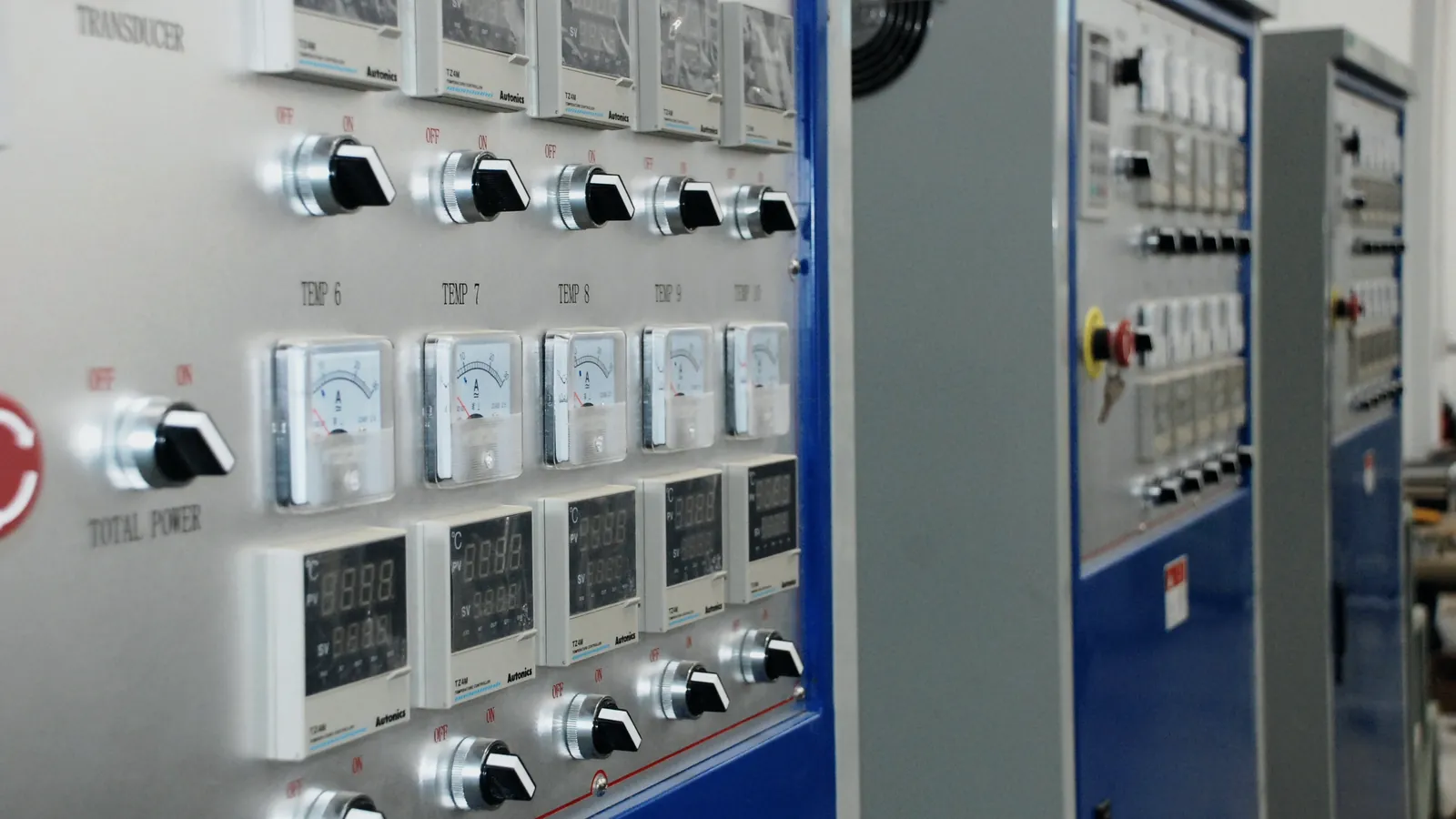
PLC and DCS are controllers that run control logic, SCADA is a supervisory system that collects data from many controllers, and an HMI is the screen where operators see and operate the process.
The four terms are often used as if they were alternatives, but most plants use two or three of them together. This guide sets them side by side, shows where each sits in a plant and explains how to decide what a site needs. For the full picture of the supervisory layer, start with what SCADA is and how its architecture works; for the controller itself, see what a PLC is.
Comparison
The short answer in one table
The simplest way to tell them apart is to ask what each one is responsible for. Controllers decide, supervisory systems watch and record, and screens let people take part.
The table compares their job, scale and typical use. The product names in the last row are the ones that appear in Citia project records, not a market survey.
| Criterion | PLC | DCS | SCADA | HMI |
|---|---|---|---|---|
| What it is | Industrial controller | Integrated control system | Supervisory software and servers | Operator screen |
| Main job | Run logic and interlocks for a machine or area | Run many control loops with one database | Collect data, alarms and history from many controllers | Show the process and accept commands |
| Typical scale | One machine to a plant section | A whole continuous plant | Many sites or scattered units | One panel to a control room |
| Chosen when | Logic is discrete or local | Loops are many and tightly linked | Units are spread out or mixed-vendor | People need to see and act |
| Seen in Citia records | Allen-Bradley, Siemens S7-1200, ABB AC500 | ABB System 800xA, Schneider Quantum | AVEVA InTouch, InduSoft, Vijeo Citect | Panels and operator stations |
Architecture
Where each one sits in a plant
Each system has its own level in the plant hierarchy. Seeing them as layers removes most of the confusion.
ISA-95, the ISA model for linking plant control to business systems, puts sensors and actuators at level 1, PLCs and DCS controllers at level 2, and SCADA with manufacturing operations at level 3. Business planning and ERP sit at level 4. HMIs appear wherever people need a view: on a machine, in a control room, or inside a DCS operator station.
NIST SP 800-82 Rev. 3, the US guide to operational technology security, describes the same families of systems from a security angle. Its point for owners is practical: every layer is a separate asset with its own software, accounts and backups.
Safety systems sit beside these layers, not inside them. An emergency shutdown or safety instrumented system (SIS) has its own controller, often a safety PLC, so that a fault in the PLC, DCS or SCADA cannot block a protective action. SCADA and the DCS usually show its status and record its trips, but they do not replace it.
Transmitters, switches, valves and motors (ISA-95 level 1).
Hover, focus or tap a step to read its note.Controllers
PLC vs DCS: where the line blurs
A PLC and a DCS both run control logic, so the difference is less about what they do and more about how the system around them is built.
A DCS (distributed control system) comes as one package. Controllers, I/O, operator stations, the alarm system and the engineering tool share a single database, so a tag defined once appears everywhere. Redundant controllers and networks are normal. That integration suits refineries and continuous plants with many analog loops that interact.
A PLC-based system is assembled. The PLC, SCADA software, network and HMI may come from different vendors and are joined through drivers and protocols. It is flexible and suits discrete logic, packaged equipment and sites that grow area by area. The price of that flexibility is integration work: every tag, alarm and address has to be mapped between products.
Modern products overlap. Some PLC families support redundancy and large I/O counts, and some DCS platforms are sold for small plants. Decide on the needs of the process, not on the label.
The choice also shapes the long term. A DCS ties the site to one vendor's upgrade path, which simplifies planning but narrows the options. A mixed PLC and SCADA system can be renewed piece by piece, yet every piece has its own lifecycle to track. The trade-offs are compared in repairing or migrating obsolete PLC and SCADA.
Supervision
SCADA vs HMI: the system and the screen
An HMI is a screen; SCADA is the system behind many screens. People mix them up because a SCADA operator station is also an HMI.
A local HMI panel on a pump skid talks to one PLC, shows that machine and keeps little or no history. SCADA polls many controllers, evaluates alarms centrally, stores history in a historian and serves several operator stations at once. A DCS has its own operator stations, which are HMIs tied to the DCS database. Many fuel terminals keep local HMI panels on pump skids or gantries even with SCADA in place, as a fallback when the link to the control room is lost.
ISA-101 is the ISA series of standards for designing and maintaining HMIs in process automation, whatever system sits behind them. How to apply it is covered in HMI design that helps operators.
- Local HMI panel
- One machine or skid, one PLC, little history
- SCADA operator station
- Many controllers, central alarms, historian, several users
- DCS operator station
- Part of the DCS, shares its database and alarms
- Engineering workstation
- Configures controllers and screens; not for daily operation
Remote sites
Where RTUs fit
An RTU (remote terminal unit) is a controller built for remote or scattered sites that reports to SCADA over long links. Think of it as a PLC designed for distance.
RTUs appear where the control room is far away: island berths, pipeline stations and remote pump houses. They are built to cope with slow or interrupted links, often buffering data and sending it when the link returns. At an island berth for LPG or fuel unloading, for example, the RTU gathers instrument data so SCADA can show it in real time; the island berth RTU and SCADA bulletin describes that setup.
In practice the line between RTU and PLC is thin. Many sites use a PLC with a good communication module in the RTU role, and project documents may say RTU/PLC for the same box.
Pipelines show why the link matters as much as the controller. On the Balongan-Plumpang fuel pipeline, pressure transmitters, RTU/PLC devices and field panels report to SCADA over fibre optic. When converters degraded, data dropped intermittently and the shutdown trigger path was affected, until Citia replaced the converters and retested monitoring and shutdown. See the Balongan PressMon restoration.
From the field
Examples from Citia projects
Real sites rarely fit one label. These examples from Citia records show the mix.
- The Lomanis fuel terminal runs an ABB System 800xA DCS as its monitoring and control centre. After a PLN power failure and lightning, Citia traced alarms and signals from field to I/O module to HMI. See the Lomanis DCS recovery.
- At PGN Labuhan Maringgai, a Schneider Quantum DCS handles gas station control, the safety system and fire and gas control in a redundant, high-availability setup. See the Labuhan Maringgai note.
- At Petrokimia Gresik, redundant ABB AC 800F controllers with Freelance monitor 6 kV and 20 kV switchgear. Citia recovered the engineering station and re-programmed the system. See the Petrokimia Gresik repair.
- At Eltech in Bekasi, a local monitoring system became part of the central SCADA after Modbus addressing and IP changes. See the Eltech HMI integration.
Decision
How to decide what a site needs
Start from the process and the people, not from a product list. The questions on the right, answered in order, usually point to the right mix.
A fuel terminal with separate tank, pump and loading areas often ends up with PLCs per area and SCADA on top. A refinery unit with many interacting loops leans toward a DCS. Many sites have both, joined at the SCADA or historian level.
Whatever the mix, plan for the long run: who supports each layer, which spare parts are stocked and how backups are kept. Budget for people as well as hardware: operators need training on each screen style, and maintenance staff need the engineering software and licences for every controller brand on site. Reliability problems usually start at the joins between layers, as the PLC/SCADA assessment guide explains.
Map the process
Continuous loops, discrete sequences or both?
Map the geography
One building, or units spread over kilometres?
List what operators must see
Defines HMI and SCADA scope.
Check the installed base
Existing controllers, skills and spares.
Plan support and backups
Who maintains each layer for its whole life.
Terms to know
- PLC
- Programmable logic controller: runs logic and interlocks for a machine or process area.
- DCS
- Distributed control system: controllers, operator stations and engineering tools sharing one database.
- SCADA
- Supervisory Control and Data Acquisition: collects data and alarms from many controllers and sends supervisory commands.
- HMI
- Human machine interface: the screen where operators see and run the process.
- RTU
- Remote terminal unit: a controller for remote or scattered sites that reports to SCADA.
- Operator station
- A computer with HMI screens used by operators for daily work.
- Engineering workstation
- The computer used to configure and program controllers and screens.
Frequently asked questions
Can SCADA work without a PLC?
Yes, SCADA can read RTUs, gateways or smart devices directly, but it still needs some controller or device in the field. In most plants that device is a PLC, because SCADA itself should not run fast or protective logic.
When does a plant use a DCS instead of PLCs?
A plant usually chooses a DCS when it has many interacting analog loops in one continuous process, such as a refinery unit. The single database, built-in redundancy and integrated alarm system pay off at that scale.
Is an HMI the same as SCADA?
No, an HMI is a screen and SCADA is the system behind many screens. A SCADA operator station is an HMI, but a local HMI panel on a machine is not a SCADA system because it has no central alarms or history.
What is an RTU?
An RTU (remote terminal unit) is a field controller for remote or scattered sites that reports to SCADA over long communication links. It is common at jetties, pipeline stations and remote pump houses.
Can PLCs and a DCS be used in the same plant?
Yes, and it is common: package equipment often arrives with its own PLC, which then reports to the plant DCS or SCADA. The work is in mapping tags and alarms between the two systems and agreeing who owns each signal.
Is a DCS more reliable than a PLC system?
Not by default; reliability depends on design, redundancy, maintenance and backups more than on the label. A well-maintained PLC and SCADA system can be dependable, and a neglected DCS can fail like any other system.
Sources and further reading
- NIST SP 800-82 Rev. 3: Guide to Operational Technology (OT) Security (opens in a new tab)
- ISA-95 Standard: Enterprise-Control System Integration (opens in a new tab)
- ISA-101 Series of Standards (opens in a new tab)
- ABB DCS programming at Lomanis fuel terminal (opens in a new tab)
- PGN: Labuhan Maringgai (opens in a new tab)
- Island berth control: RTU integration and SCADA (opens in a new tab)
- Cover photo by Poly-protech, CC BY-SA 4.0 (cropped and colour graded) (opens in a new tab)
Next step
Prepare the technical discussion for your facility.
Bring the equipment list, diagrams and symptoms you have. The Citia team helps map the next step.
Related products and solutions
- KnowledgeWhat is a PLC? How it works, types and where it is usedA PLC reads inputs, runs logic in a repeating scan and drives outputs. How the scan works, what is in a PLC panel, the languages and the main types.
- KnowledgeWhat is SCADA? Components, architecture and industrial examplesSCADA collects data from PLCs, RTUs and instruments, shows it to operators and sends supervisory commands. Components, architecture and real plant examples.
- KnowledgeHMI design that helps operators: layout, colour and alarmsGood HMI screens make abnormal states stand out, use colour only for meaning and go from overview to detail. ISA-101 practice, alarm load and field notes.
- ProjectABB DCS programming at Lomanis fuel terminalTroubleshooting and recovery of the ABB System 800xA DCS at the Lomanis fuel terminal.
- ProjectPetrokimia Gresik: ABB PLC repairRepair, recovery and re-programming of the ABB AC 800F and Freelance control system that monitors the 6 kV and 20 kV switchgear in the coal unit at PT Petrokimia Gresik.
- NewsPGN: Labuhan MaringgaiA reference for Schneider Quantum DCS gas pipeline station control, safety systems, and fire and gas control.
- ProjectEltech: busbar panel monitoring into central SCADAPower, humidity and temperature monitoring on an Eltech busbar panel was added to the existing central SCADA through a LAN-to-Ethernet converter and Modbus.
- NewsIsland berth control: RTU integration and SCADACovers RTU and SCADA integration for LPG and fuel unloading at island berths, including instrument monitoring, maintenance and calibration.
- KnowledgePLC/SCADA assessment: start with symptoms, topology and backupsSeparate equipment, communications, applications and operating processes before deciding on replacement.