
Process Safety
Hazardous areas and explosion-proof equipment: zones and Ex certification
Hazardous areas are split into Zone 0, 1 and 2 by how often an explosive atmosphere appears; electrical equipment in them needs an Ex certificate that matches the zone.
- Topic
- Process Safety
- Updated
- 13 November 2026
- Reading time
- 6 min
- Sections
- 8
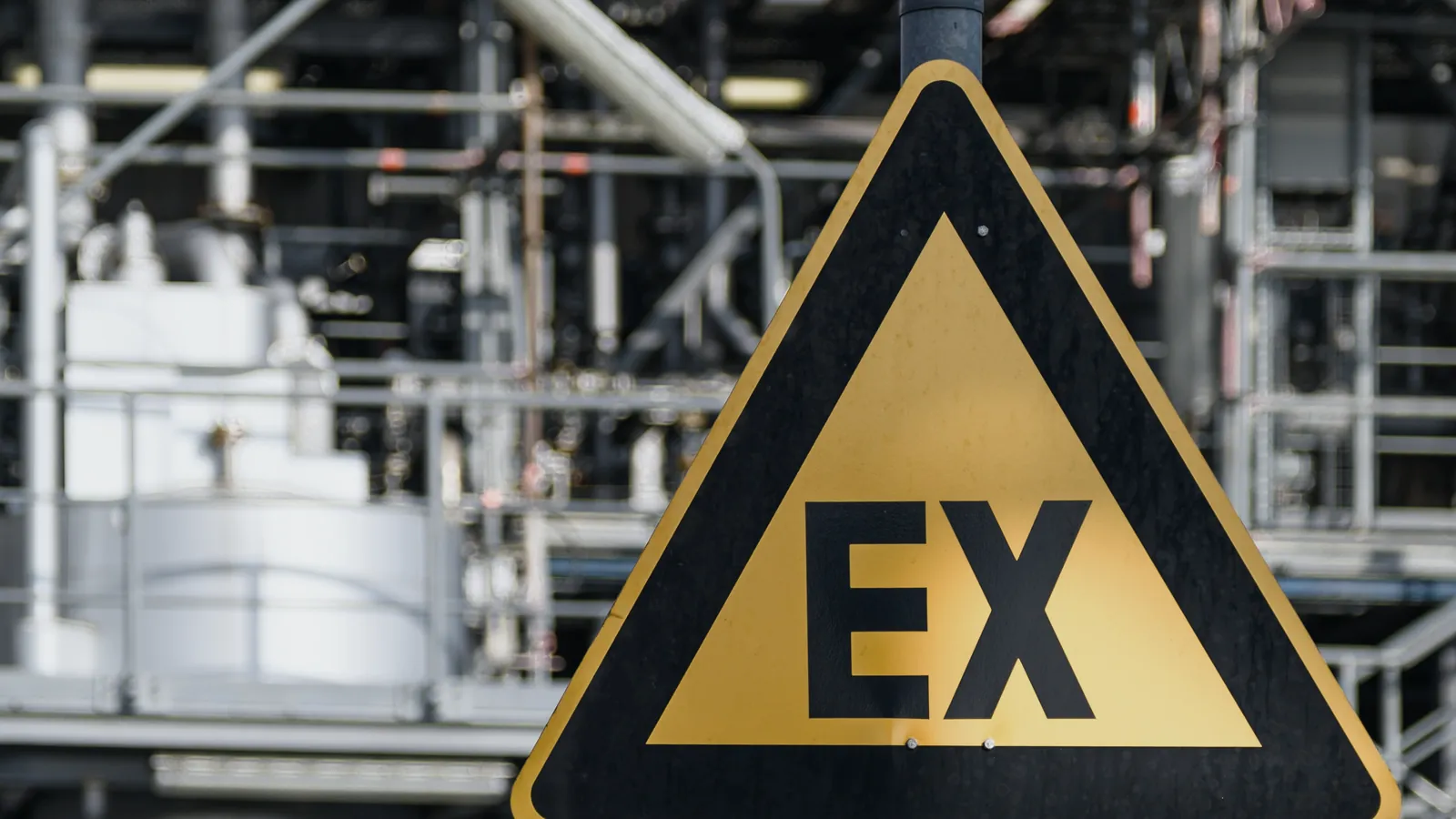
Hazardous area classification is the process of mapping where flammable gas, vapour or dust may be present in dangerous amounts, so that electrical equipment and other ignition sources there can be controlled. For gases and vapours the areas are divided into Zone 0, Zone 1 and Zone 2 by how often an explosive atmosphere appears, and electrical equipment inside them must carry an Ex certification that matches the zone.
"Explosion-proof" is the everyday word for equipment built to work safely in these areas. Strictly it names one method, the flameproof enclosure (Ex d), so this guide says "Ex equipment" for the whole family. It also covers the codes on a nameplate and the difference between ATEX and IECEx. For the shutdown functions that protect the same areas, read ESD, SIS and interlock.
Basics
Why some areas are classified
An explosion needs three things at once: fuel mixed with air in the right proportion, oxygen, and a source of ignition. At a fuel terminal the fuel is gasoline or LPG vapour and the air is everywhere, so the one element engineers can control is the ignition source.
Area classification does that job on paper first. A process safety engineer studies every point where vapour can escape, such as vents, pump seals, loading arm couplings, sample points and drains, and draws zones around them. IEC 60079-10-1 sets out the method for gases and vapours. Dust has its own zones, 20, 21 and 22, under IEC 60079-10-2. The drawing then becomes a design input that tells electrical and instrument engineers which equipment may go where.
Classification does not remove the vapour, and it does not say an area is dangerous all the time. It says how likely an explosive atmosphere is, and that likelihood sets how strict the equipment rules become. The site owner carries the responsibility, and the study must be reopened when the product, the process or the layout changes.
Products matter. Gasoline vapour can form an explosive atmosphere at normal ambient temperature, while diesel has a higher flash point and usually does not unless it is heated or sprayed as a mist. The study should state this for each product the site handles.
Zones
Zone 0, Zone 1 and Zone 2
The zone number describes how often an explosive gas atmosphere is present. It does not describe how violent an explosion would be.
- Zone 0. Present continuously, for long periods or frequently. The space above the liquid in a fixed-roof tank is the usual example.
- Zone 1. Likely to occur occasionally in normal operation. Tank vents and loading arm connections are typical.
- Zone 2. Not likely in normal operation, and if it occurs it lasts only a short time. It often forms the outer ring around Zone 1.
These definitions follow IEC 60079-10-1.
- Inside a fixed-roof tank, above the liquid
- Zone 0
- Around a tank vent outlet
- Zone 1, with Zone 2 beyond it
- Loading arm coupling and truck hatch during loading
- Zone 1 near the opening, Zone 2 further out
- Pump seal area in an open-air pump bay
- Often Zone 2; Zone 1 where leaks are expected
- Control room with positive air pressure
- Safe area, if the study confirms it
Illustrative only. The real extents come from the site's classification drawing.
| Criterion | Zone 0 | Zone 1 | Zone 2 |
|---|---|---|---|
| Equipment protection level | Ga | Gb | Gc |
| ATEX equipment category | 1G | 2G | 3G |
| Typical protection types | Intrinsic safety Ex ia, or special measures | Ex d, Ex e, Ex i, Ex p | Zone 1 types, or Ex n and Ex ec |
Equipment with a higher protection level may be used in a lower-risk zone, so a Gb device is fine in Zone 2. The reverse is not allowed.
Some older installations designed to American practice use Class I, Division 1 and Division 2 instead of zones. Division 1 roughly corresponds to Zones 0 and 1, and Division 2 to Zone 2. When you meet both systems on one site, ask for the classification to be restated in zones before you compare certificates.
Method
What sets the zone: release and ventilation
Engineers do not guess zones. They list each source of release, ask how often and how much it releases, and then ask how well air carries the vapour away.
IEC 60079-10-1 sorts releases into three grades. Continuous grade: vapour is released continuously or for long periods, like the liquid surface in a fixed-roof tank. Primary grade: release is expected occasionally in normal operation, for example a vent that breathes during filling or a coupling that is disconnected. Secondary grade: release is not expected in normal operation and would be short, such as at a pump seal or flange that leaks only when something fails.
Ventilation then adjusts the result. In the open air with some wind, vapour disperses quickly and the zone shrinks. In a closed pump house with little air change, the same release produces a larger zone, and weak ventilation can raise the zone type. Vapour density matters too. LPG and gasoline vapour are heavier than air and collect in pits, trenches and low points, so the classification often reaches further at ground level than the equipment itself suggests.
That is why classification drawings show a plan and a section. Zones have height, and a cable trench that leaves a zone can carry vapour out with it.
Continuous grade
Tends to give Zone 0 where ventilation is poor, as inside a fixed-roof tank.
Primary grade
Tends to give Zone 1, as at a tank vent or a loading arm coupling.
Secondary grade
Tends to give Zone 2, as around a pump seal that leaks only on failure.
Protection
Ex d, Ex e, Ex i and Ex p
Equipment for hazardous areas either keeps an ignition from starting or keeps an explosion contained. IEC 60079-0 sets the general rules, and each method has its own part of the series. The method is shown by a letter in the Ex code.
Pick the method for the job. Motors and switchgear commonly sit in flameproof or increased safety enclosures. Transmitters and switches on a 4-20 mA loop often use intrinsic safety. Analyser cabinets and large panels can be pressurised. Intrinsic safety, Ex ia, is the usual way to put an instrument in Zone 0, and the Citia bulletin on an early warning system describes ex-proof sensors suitable for Zone 0 at storage areas.
| Criterion | Ex d flameproof | Ex e increased safety | Ex i intrinsic safety | Ex p pressurisation |
|---|---|---|---|---|
| How it works | The enclosure withstands an internal explosion and cools escaping gas through precise joints | The design prevents arcs, sparks and hot surfaces in normal operation | The circuit energy stays below what can ignite the gas | Clean air or inert gas keeps the enclosure at positive pressure so vapour cannot enter |
| Typical use at a terminal | Motors, junction boxes, luminaires, switches | Terminal boxes and cable junctions | Transmitters, switches and solenoids on instrument loops | Analyser houses and large panels |
| Watch for on site | Damaged or painted flange faces; do not open an energised enclosure in the area | Loose terminations and the wrong cable gland | Loop calculation: device and cable values must fit the barrier | Purge before power-up, and an alarm or trip when pressure is lost |
Nameplate
How to read an Ex marking
II 2G  Ex db IIB T4 Gb

II   equipment group (surface industries)
2G   ATEX category 2, gas
Ex   explosion protection
db   flameproof, level of protection b
IIB  gas group B (covers group A gases)
T4   surface stays below 135 °C
Gb equipment protection level: Zone 1Check four things, in this order. First, the equipment protection level must cover the zone. Second, the gas group must be at least that of the product. Third, the temperature class must keep the surface below the ignition temperature of the product. Fourth, the ambient range on the nameplate must cover the site.
Gasoline vapour is commonly listed as gas group IIA and temperature class T3. The safety data sheet and the classification study confirm it for your product. By that reading, this box is acceptable in Zone 1.
- T1
- Maximum surface temperature 450 °C
- T2
- Maximum surface temperature 300 °C
- T3
- Maximum surface temperature 200 °C
- T4
- Maximum surface temperature 135 °C
- T5
- Maximum surface temperature 100 °C
- T6
- Maximum surface temperature 85 °C
The temperature classes above come from IEC 60079-0. A lower number allows a hotter surface, so T4 is stricter than T3 and T6 is the strictest.
Certification
ATEX and IECEx in Indonesia
ATEX and IECEx both certify equipment for explosive atmospheres, and both rest on the IEC 60079 standards. They are different instruments. ATEX is European Union law, named from the French "atmosphères explosibles". Directive 2014/34/EU covers equipment placed on the EU market, and Directive 1999/92/EC covers the duties of employers. IECEx is a voluntary international scheme under the IEC, with certificates in a public online database.
An Indonesian site is not under the ATEX directives, because those apply in the EU. Project specifications may call for the IEC 60079 series, IECEx certificates or ATEX certificates, so ask which one the owner accepts. The national standards body, BSN, issues SNI documents that adopt parts of the IEC 60079 series. Confirm the current list with BSN before you quote a standard number in a tender.
| Criterion | ATEX | IECEx |
|---|---|---|
| What it is | European Union directives | International certification scheme under the IEC |
| Legal status | Mandatory for equipment sold in the EU | Voluntary; often named in contracts and national rules |
| Standards used | Harmonised European standards, EN IEC 60079 series | IEC 60079 series directly |
| Who certifies | Notified bodies for the higher categories; some by manufacturer declaration | IECEx certification bodies and test laboratories |
| Marking | CE mark, Ex symbol, group and category such as II 2G | Ex code with an IECEx certificate number |
| Where to check | EU declaration of conformity and certificate | IECEx online certificate database |
Beyond Ex
Ignition sources beyond electrical equipment
Ex certification covers electrical and instrument equipment, yet it is only part of the control. In a classified area, hot surfaces, mechanical sparks, hot work, static electricity and stray currents can ignite vapour too.
Permit to work covers hot work and non-Ex tools. Handheld devices such as phones, torches and cameras need an Ex rating or a permit that says the area is gas-free. Non-electrical equipment such as pumps, couplings and valves has its own explosion protection standard, ISO 80079-36. Static charge on a loading truck is a separate topic, covered in static grounding during fuel loading.
Vapour can also travel where nobody looks. Cable and conduit entries between a classified area and a safe room need seals or barrier glands, otherwise vapour moves along the cable into the control room or panel room.
Practice
Choosing and inspecting Ex equipment
Get the classification drawing
Zones, gas group and temperature class for each product handled.
Match zone to protection level
Ga for Zone 0, Gb for Zone 1, Gc for Zone 2, or higher.
Check group and temperature class
Both must fit the product, and the ambient range must fit the site.
Read the certificate
An "X" at the end of a certificate number means special conditions of use apply.
Install to IEC 60079-14
Certified cable glands and plugs, correct cable, earthing and bonding.
Inspect to IEC 60079-17
Keep records, and re-inspect after any repair or change.
Citia's field instrumentation service prepares the datasheets and I/O lists where the Ex marking, gas group and temperature class of each instrument are recorded. The site installation crews work under permit to work and lockout-tagout, including grounding and cable termination.
Terms used in this article
- Hazardous area
- A place where flammable gas, vapour or dust may be present in dangerous amounts.
- Zone
- A class of hazardous area by frequency of explosive atmosphere: 0, 1 or 2 for gas.
- Ex equipment
- Equipment certified to be used in an explosive atmosphere without igniting it.
- EPL
- Equipment protection level: Ga, Gb or Gc for gas, linked to Zone 0, 1 or 2.
- Gas group
- IIA, IIB or IIC, grouping gases by how easily they ignite.
- Temperature class
- T1 to T6: the highest surface temperature the equipment may reach.
- LEL
- Lower explosive limit: the lowest gas concentration in air that can burn.
- Flash point
- The lowest liquid temperature at which enough vapour forms to ignite.
- ATEX
- European Union directives for equipment and workplaces with explosive atmospheres.
- IECEx
- International certification scheme for Ex equipment, based on IEC 60079.
Frequently asked questions
What is the difference between Zone 1 and Zone 2?
Zone 1 is where an explosive gas atmosphere is likely to occur occasionally in normal operation, while in Zone 2 it is not likely and, if it occurs, it lasts only a short time. Zone 1 needs equipment with a higher protection level (Gb). Zone 2 accepts Gc, and Gb equipment also works there.
What does Ex d IIB T4 mean?
It describes flameproof equipment (Ex d) for gas group IIB with a maximum surface temperature of 135 °C (T4). Group IIB equipment also covers IIA gases. A full marking adds the protection level, such as Gb for Zone 1, and the ambient range on the nameplate.
Does ATEX apply in Indonesia?
ATEX is European Union law, so it does not bind an Indonesian site by itself. Project specifications can still require ATEX or IECEx certificates, and Indonesian requirements apply alongside them. Ask the owner which certificates they accept before ordering equipment.
Is "explosion proof" the same as Ex equipment?
Not exactly. Explosion-proof usually means the flameproof method, Ex d, in which the enclosure contains an internal explosion. Ex equipment is the wider family, which also includes intrinsic safety, increased safety and pressurisation. A panel sold as "explosion proof" still needs a certificate that names its Ex code.
Is an area that handles only diesel hazardous?
It depends on the study. Diesel has a higher flash point than gasoline, so below that temperature it usually does not form an explosive atmosphere, but heating, spraying or a mixed-product tank can change that. The classification study states the result for each product.
Who classifies the hazardous areas on a site?
The site owner is responsible, usually through a competent process safety engineer who follows IEC 60079-10-1. The result is a classification drawing with zones, gas group and temperature class. Instrument and electrical suppliers use it but do not set it.
Can I use a Zone 1 device in Zone 2?
Yes, if the device's protection level is Gb or higher, it can be used in Zone 2 as well. The gas group and temperature class must still fit the product. A Zone 2 device must not be moved into Zone 1.
Sources and further reading
- IEC 60079-10-1:2020 Explosive atmospheres, classification of areas, explosive gas atmospheres (opens in a new tab)
- IEC 60079-0 Explosive atmospheres, equipment, general requirements (opens in a new tab)
- About IECEx (opens in a new tab)
- ATEX and explosive atmospheres (opens in a new tab)
- Badan Standardisasi Nasional (SNI) (opens in a new tab)
- Early warning systems for fuel terminal operations (opens in a new tab)
- Field instrumentation service (opens in a new tab)
- Cover photo by CEphoto, Uwe Aranas, CC BY-SA 4.0 (cropped and colour graded) (opens in a new tab)
Next step
Prepare the technical discussion for your facility.
Bring the equipment list, diagrams and symptoms you have. The Citia team helps map the next step.
Related products and solutions
- KnowledgeStatic grounding during fuel loadingGrounding a tank truck during loading drains the static charge that fuel flow builds up, so no spark forms near vapour; a verification unit blocks loading until the connection is proven.
- KnowledgeFire and gas systems and early warning at fuel terminalsA fire and gas system detects fire and flammable gas, sounds alarms and trips the process; this guide covers detectors, logic, early warning and PAGA at fuel terminals.
- ProductField InstrumentationSelects, installs, calibrates and commissions the instruments that measure your process.
- ProductSite Installation & ManpowerInstalls panels, cables and instruments on site, with a technical crew that works safely.
- NewsEarly warning systems for fuel terminal safety monitoringCovers Early Warning Systems at fuel terminals, including hazard detection, ex-proof sensors and monitoring integration.
- ProjectBalongan filling shed: grounding system assessmentBalongan filling shed grounding module is dead and past its service life; servicing is recommended because static electricity can cause fire and explosion.
- KnowledgeESD vs SIS vs interlock, and what SIL meansEmergency shutdown (ESD) brings a process to a safe state; built to IEC 61511 with a target SIL, it becomes part of a safety instrumented system (SIS).